Table of contents
When travel memories resurface months later, they rarely follow the logic of guidebooks, and an unexpected detail often outranks the landmark: the first coffee of the day, the smell of warm bread, the table where a couple planned their route. Psychologists have long noted that everyday rituals anchor emotions more firmly than spectacles, and in tourism, breakfast has quietly become a battleground for loyalty. Hotels know it, guests feel it, and cities like Paris offer a particularly sharp laboratory for understanding why morning plates can outshine monuments.
Breakfast hits where memory sticks
Why does a croissant linger longer than a cathedral? Part of the answer lies in how human memory works, and the mechanisms are well documented. Cognitive psychologists distinguish between episodic memory, the recollection of a specific moment with context, and semantic memory, the repository of facts. A monument often becomes semantic quickly, a box ticked, a name filed, a façade photographed, whereas breakfast tends to remain episodic because it is multisensory, repeated, and emotionally “safe.” Studies on food and memory repeatedly point to the power of smell and taste, with olfaction enjoying a direct neurological route to the limbic system, the brain’s emotional hub; in practical terms, the aroma of coffee or buttered pastry is primed to pull a traveler back into a scene with unusual force.
It is also a matter of timing. Breakfast happens when the day’s cognitive load is low, before crowds, queues, and navigation stress accumulate, and that makes it more likely to be encoded with clarity. The travel industry has its own language for this, and the data backs it up. In the American Customer Satisfaction Index’s Travel Report, hotels consistently rank among the strongest performers in the broader travel category, and within hotels, food and beverage experiences are repeatedly flagged in guest feedback as drivers of perceived value. Review platforms offer a blunt illustration: in many cities, “breakfast” is among the most frequently cited nouns in hotel reviews, often used to justify a higher price or to forgive small flaws, and, conversely, to amplify disappointment when it misses expectations. A landmark can be impressive and still feel “external,” but breakfast is intimate, and intimacy is sticky.
Hotels are turning mornings into strategy
Forget the continental cliché. In an era of compression, fewer trips, shorter stays, higher nightly rates, breakfast has become one of the clearest opportunities for a hotel to differentiate without asking a guest for extra time. Industry trackers have already mapped this shift. STR data shows that hotel pricing power has strengthened in many major markets since the pandemic recovery began, and as average daily rates rose, guests became more sensitive to what is included. That sensitivity pushes hoteliers to treat breakfast as both a cost line and a marketing asset, and the winning formula is rarely about abundance alone. It is about perceived care, local cues, and rhythm: good bread served warm, eggs that arrive quickly, a calm room, and staff who remember preferences without performing friendliness.
Operators also respond to a changing traveler profile. Business travel remains below its pre-2020 peak in many regions, according to Global Business Travel Association forecasts, and leisure demand has filled the gap with guests who expect experience, not just accommodation. That expectation shows up in design choices, and in procurement. Smaller hotels partner with neighborhood bakers, roasters, and cheese shops to claim authenticity, while larger chains push consistency, dietary breadth, and speed. The economics explain the obsession. Food costs are volatile, labor remains tight across hospitality markets, and breakfast is one of the few daily touchpoints every guest is likely to encounter. If a hotel nails that moment, it creates a halo effect: the room feels quieter, the location feels smarter, the city feels kinder, and the traveler, consciously or not, credits the hotel for a good day.
Paris makes breakfast a travel headline
Paris is not merely a postcard city, it is a city where morning culture is part of the narrative, and that changes the emotional stakes of breakfast. Visitors arrive with a script in mind, the terrace, the café crème, the flaky viennoiserie, and the city often meets them halfway. Yet the very popularity of those rituals can make them harder to access: queues form early at famous boulangeries, prices in touristic zones climb, and not every traveler wants to navigate an unfamiliar neighborhood before their first caffeine. In that context, a hotel breakfast can function as a shortcut to “Paris-ness,” delivering local references without the friction, and that is precisely why it sticks in memory. A traveler might struggle to recall which wing of the Louvre held a particular painting, but they will remember the butter that tasted different, the jam that felt homemade, and the quiet table by the window as scooters started to buzz outside.
Paris also magnifies contrasts, and contrasts are memory accelerants. One morning can move from silence to spectacle in minutes, a soft start inside followed by the intensity of metro transfers, museum crowds, and long walks. Because breakfast sits at the hinge of that transition, it becomes the emotional “before” that frames the “after.” For travelers choosing where to stay, that framing matters. A centrally placed, well-run small property can turn a complicated itinerary into something manageable, and it can do so through mundane excellence: good coffee, reliable timing, space to plan, and staff who offer practical advice rather than generic cheer. Those looking for a Boutique hotel in Paris often cite exactly these details, the sense that the day begins with calm competence, not with logistical improvisation, and in a city that can overwhelm, calm becomes luxury.
Monuments impress, breakfasts bond
Monuments are designed to be seen, and their grandeur is public, shared, and, increasingly, mediated through screens. Travelers arrive with images already implanted, and that familiarity can dilute surprise, even when the real thing is extraordinary. Breakfast, by contrast, is lived rather than viewed. It is private, bodily, and interactive, shaped by temperature, texture, light, and conversation. Behavioral researchers have a concept known as the “peak-end rule,” popularized by psychologist Daniel Kahneman, which suggests people judge experiences largely by their emotional peaks and by how they end. While breakfast is rarely a peak in the fireworks sense, it can act as a daily “end” to the night and a “beginning” to the day, and beginnings and endings are powerful anchors. If the morning starts well, the entire day inherits that glow; if it starts badly, even the best museum can feel like damage control.
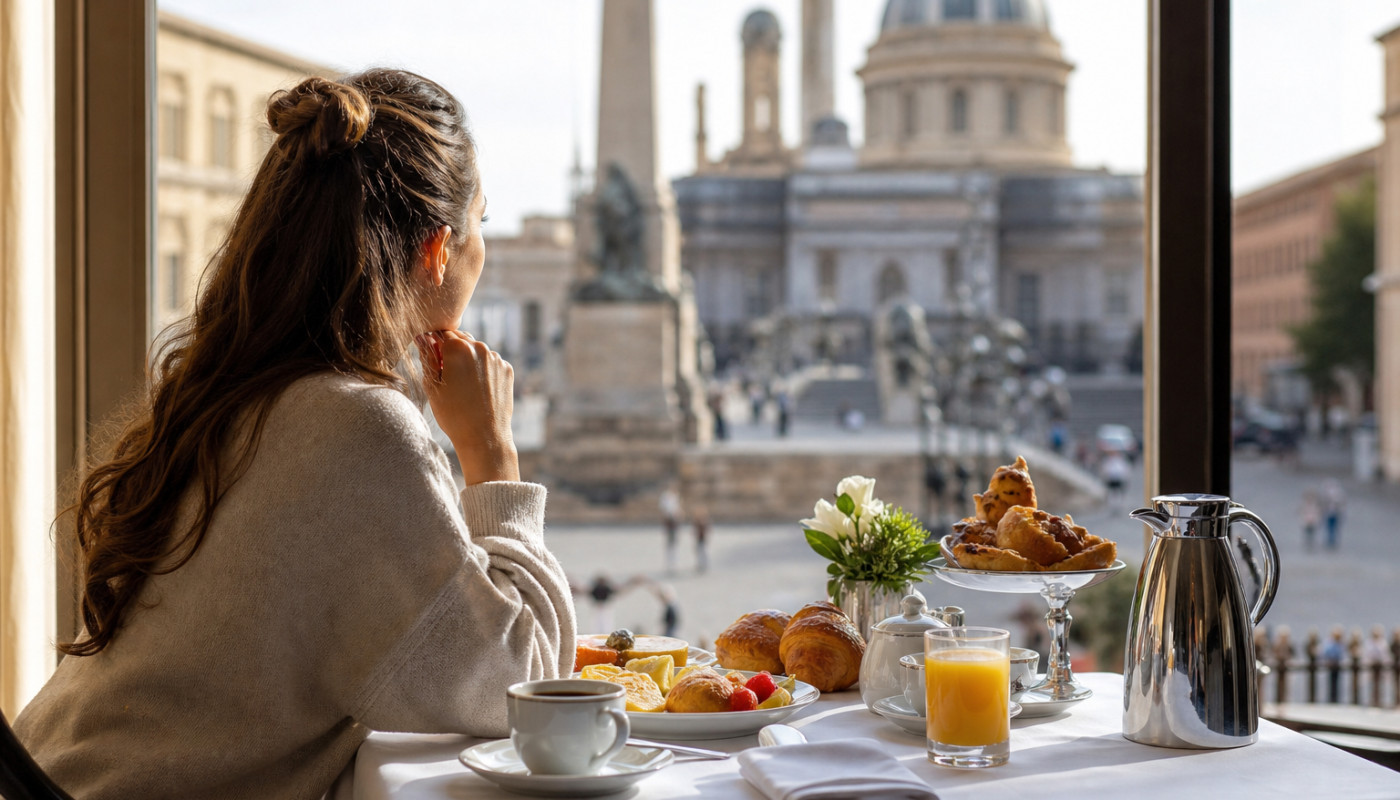
There is also the bond factor. Breakfast is where families negotiate plans, where couples decompress, where solo travelers feel briefly part of a scene, and those micro-social moments become the story people tell later. Ask travelers what they remember, and many will mention who sat where, what they talked about, and how the city looked through a breakfast-room window. In that sense, breakfast is less about food than about permission: permission to slow down, to be cared for, to gather confidence before stepping into a busy urban stage. Monuments offer narrative, but breakfasts offer relationship, and relationship is what memory protects. That is why a simple plate, repeated over two or three mornings, can outlast a single awe-filled visit, and why hotels that treat breakfast as a craft, not a checkbox, often earn loyalty beyond their star rating.
Before you book, check the morning details
To make breakfast work for you, ask direct questions when reserving: is it included, what time does it start, and can it handle dietary needs without compromise? In Paris, budget realistically, as breakfast can add €15 to €35 per person depending on the property. If you are eligible, look for VAT receipts for expense claims, and check whether city tourism offers any partner discounts during low season.
Similar articles


